

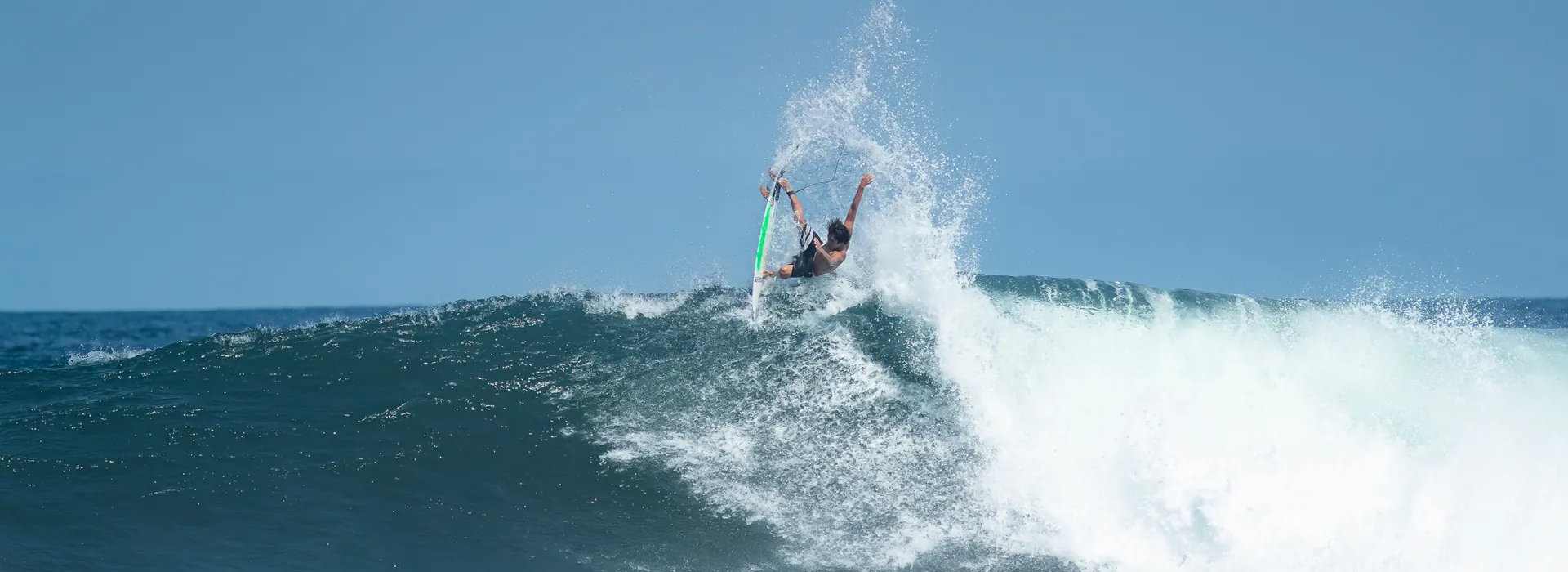
Different Surf Manoeuvres and Tricks
How to dominate in the Line Up!
Dreaming of carving turns and tricks like your favourite surf legends? It's a common aspiration for many surfers. While knowing how to do advanced manoeuvres takes time and practice, you should remember, that every surfer starts somewhere. The key is to focus on the basics and build your skills gradually.
In this post, we’ve listed 11 essential surf tricks and manoeuvres that get you going! From the beginner bottom turn to the ultimate barrel ride. Whether you're just starting or looking to bring your surfing to the next level, these tips will help you progress safely and enjoyably. So, grab your board, head to the beach, and let's surf!
Beginner Level
#1 The Pop-up
The most basic and important skill of surfing is the pop-up. is the manoeuvre of quickly standing up on your board after taking off and catching a wave. Start in a crouched position with your hands on the sides of your board. As the wave catches you, use your arms to push your upper body off the board, lifting your chest while keeping your hips low. First bring your back foot forward quickly, positioning it on the board, ideally over or just behind the fins. Then simultaneously swing your front foot forward, placing it on the board between your hands.
Try to incorporate stretching into your daily routine to improve your pop-up skills and reduce the risk of injuries. Practising the pop-up on dry land during your surfing workout can also help you develop muscle memory and improve your balance and coordination for the best pop-up!
#2 Pumping
Pumping is another fundamental technique that you use to generate speed and control your movements on a wave. It’s essential for riding the waves longer, so you have more time to perform more advanced surf manoeuvres.
It involves bending and flexing your knees, extending your legs, and using your arms to propel yourself forward. Make sure you use your arms in a synchronised motion with your legs to increase momentum.
To improve your pumping technique and practice outside the water, consider trying surfskating. Surfskating is a fun and effective way to improve your balance, coordination, and pumping skills, which will directly translate to your surfing skills. Visit our newest surf skate area in Canggu to give it a try!
#3 Bottom Turn
The bottom turn is probably one of the most crucial manoeuvres in a surfer's skill arsenal. Influencing your speed, control, and ability to ride the wave effectively, it sets the foundation for all other turns, airs, snaps and other tricks. As 11-time WSL world champion Kelly Slater once said,
"Bottom turns don't get as much attention as other aspects of riding waves, but they form the foundation for good surfing."
A bottom turn involves leaning into the wave face and redirecting your momentum and body upwards. You can either do the bottom turn on your frontside or your backside. While the basic principles of the bottom turn remain the same, there is a slight variation between each.
On a frontside bottom turn, your front foot is facing the wave. This is generally considered easier for beginners because it feels more natural and requires less coordination since your body weight is naturally shifted to your backfoot. As you initiate the turn, lean into the wave and swing your back arm behind you. Keep your front arm steady and focus on keeping your balance.
On a backside bottom turn, your back foot is facing the wave. Lean into the wave and swing your front arm towards your chest. Use your trailing arm to help you pivot and turn.
#4 Cutback
A cutback is a sharp turn back towards the breaking section of the wave. It's a stylish manoeuvre that’s often used to avoid whitewater, position yourself for another wave, ride larger waves, and it allows you to control your board.
To execute a perfect cutback, start by generating speed as you approach the breaking section of the wave. Shift your weight towards your back foot and lean into the turn, angling your body towards the direction you want to go.
Use your front foot to control the board's transition from rail to rail, applying pressure. Remember to keep your eyes focused on where you want to go and adjust your weight to keep your balance. Once you've completed the cutback, aim to return to the lip of the wave for another ride or to perform other tricks.
#5 Cross-stepping
Cross-stepping is a technique used to move up or down your surfboard, making sure you can generate speed or slow down to stay on the right part of the wave. It's particularly useful for longboards or when riding larger waves. Instead of only shifting the weight of your body, you actually need to move your feet. To cross-step, simply step your front foot behind your back foot and then step your back foot forward. This allows you to adjust your position on the board and maintain balance.
A quick way to learn how to cross step on a longboard is practising a longboard balance board. This offers benefits like improved balance, muscle memory development, risk-free practice, year-round training, immediate feedback, confidence building, and strengthening leg muscles.
#6 Duck Diving
Duck diving is more of a paddling trick rather than a surfing trick. This trick will help you navigate through breaking waves and avoid wasting energy on turtle rolling and wipeouts.
To successfully duck dive, paddle hard to gain speed and momentum. As you approach the wave, start your duck dive two metres before the wave breaks. Grab the rails beneath your chest and push the nose of the board down and forward while leaning your upper body over the board. Push the tail down with your foot or knee, lifting your other leg to put more weight on the tail. Once the wave has passed, bring your body back to your surfboard and aim the nose to the surface. With practice, the duck dive will become easier and you’ll have more energy for surfing. Practise duck diving in a pool or with smaller waves at the start.
Intermediate To Advanced Level
#7 Layback
Let’s move on to more advanced surf tricks and manoeuvres, once you know how to turn and do a cutback, this trick will definitely add some flair to your surf style! The layback snap, also known as layback hack and layback cutback, began gaining popularity in the 80s. In this stylish and timeless trick, the surfer lays down on a wave while doing an abrupt turn, using the body to slow down and bring the surfboard around.
To do a layback, start by taking off on a wave, generating speed and performing a really good bottom turn. As you approach the wave's lip, shift your weight back, bend your back leg, and lift your front leg. Lean back and extend your arms behind you, maintaining balance and control. Use your back foot to turn the board and carve a line towards the beach.
Extra tip: It's easier to perform the layback on waves with a good size and a generous wall of water. The faster you come off the bottom turn, the easier you'll complete the move.
#8 Front Side & Back Side Snaps
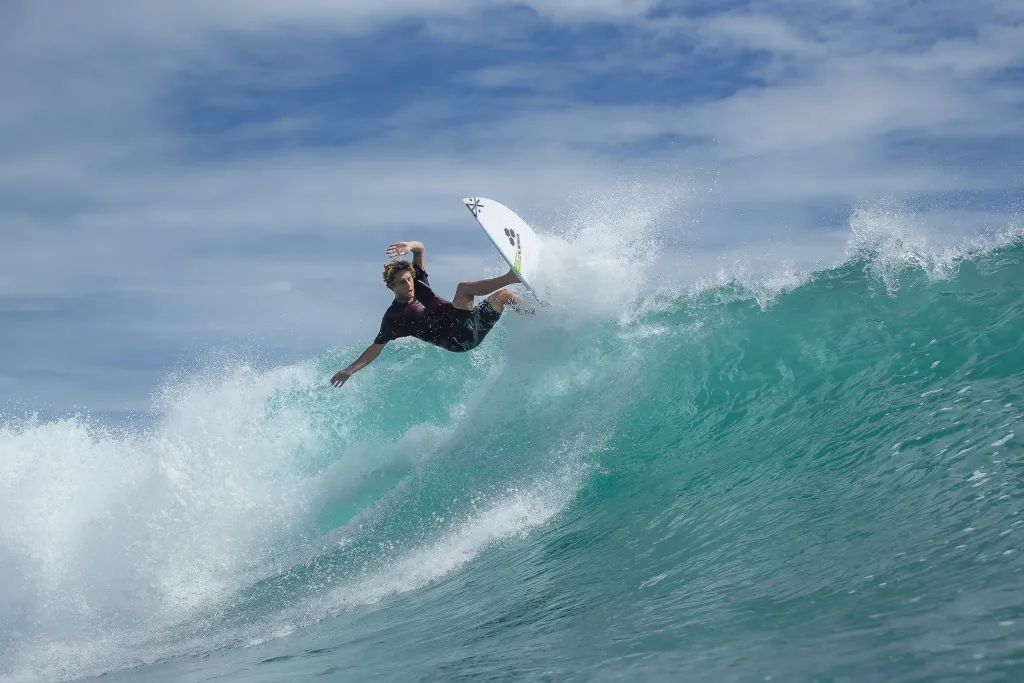
The snap turn is a dynamic and stylish move that involves speed, a quick and powerful change of direction. It's a move used by surfers of all levels to avoid obstacles, generate speed, and showcase their skills. A snap is more vertical and less on rail than other turns, such as a cutback. With this, you need a steeper wave face to perform your turn in the pocket. Too far out on the shoulder, you'll be unable to carry your momentum down the line (cutbacks are for on the shoulder, snaps for when the wave is steep). Speed and a good bottom turn are your best friends when it comes to a snap.
Learn from the pros by watching videos of professional surfers performing snap turns to analyse their technique and gain inspiration.
#9 360 / Spinaroo
Even though it might look simple and doable, the 360, also known as the spinaroo, is one of the most difficult tricks in surfing. In modern surfing, it will not earn big scores from a judging panel during a WSL game. Nevertheless, it remains a timeless and really cool surfing trick!
Advanced Level
#10 Airs
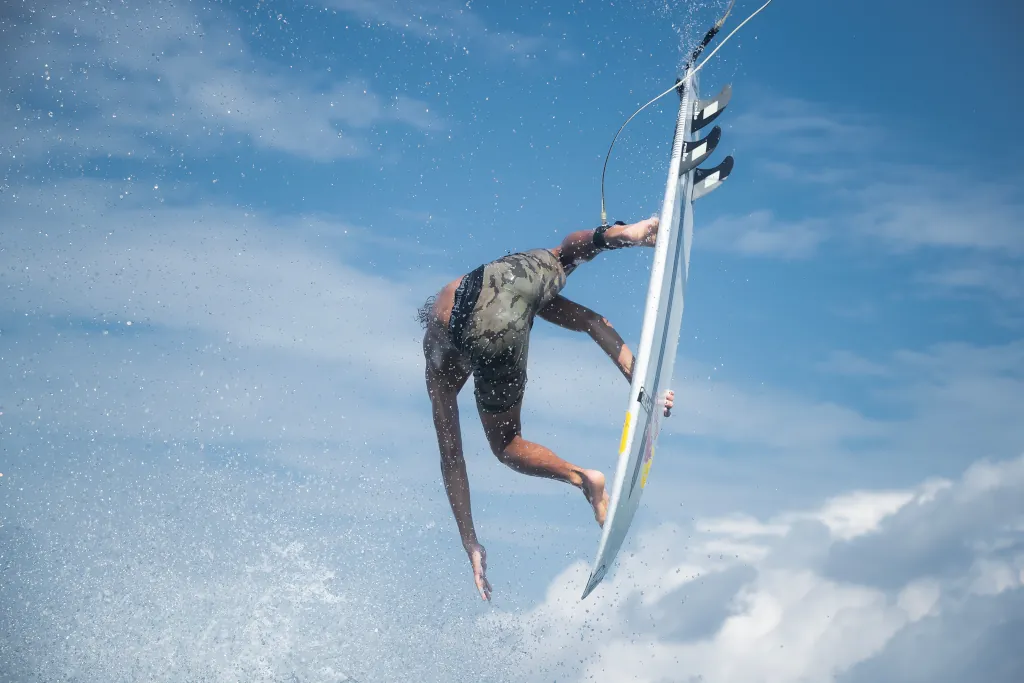
Everybody in surfing talks about doing airs, and we understand that. When you see someone pull off an air, it's quite the sight! It's a move that requires you to gain maximum speed, find a ramp or a steep slope to jump off the wave, launch in the air and hang in there. Once you've mastered the basics of aerials, you can start experimenting with different manoeuvres in the air.
Here are some of the most popular aerial tricks:
Rodeo Flip: A 360-degree rotation with a grab of the frontier back rail.
Alley-oop: A 360-degree backward rotation with a grab of the back rail.
Flynnstone Flip: A frontside rotation with a grab of the tail.
Kerrupt Flip: A backside rotation with a grab of the tail.
#11 Tube Riding
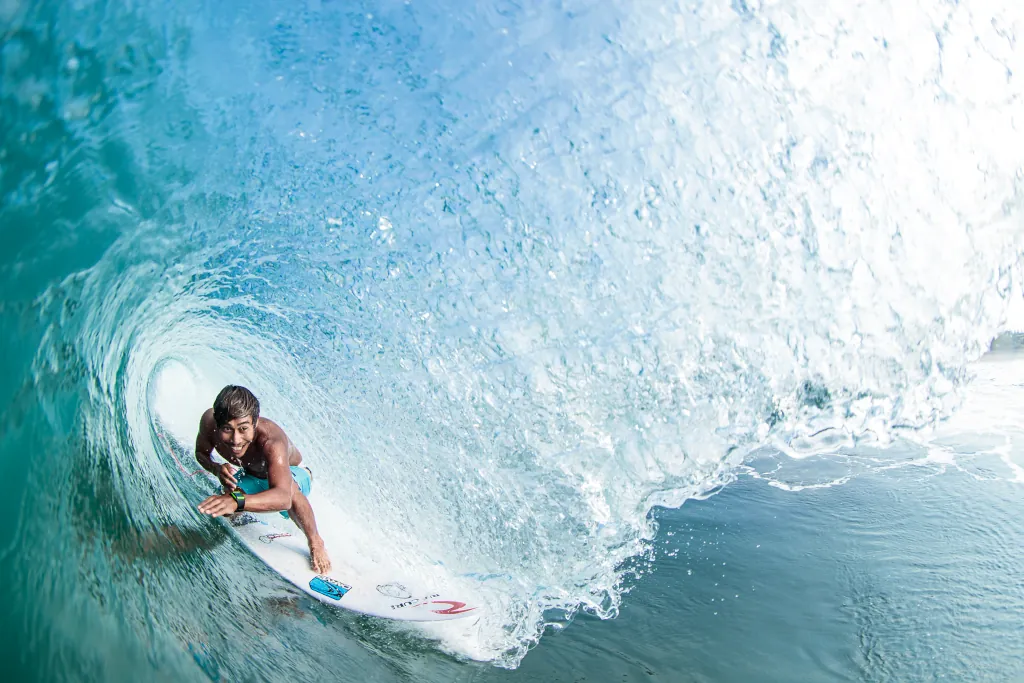
Tube riding is surfing inside the hollow part of a wave, known as the barrel, is the dream for many surfers and the ultimate surfing trick!. It requires precise timing, balance, and skill. You get an impressive and aesthetically pleasing look of the curl's lip fully covering you as you ride the hollow part of the wave. Crouch and tightly angle yourself as you drop in right ahead of the wave's lip. When inside, stay centred on your board and above the white section of the wave so you don't slow down or get thrown off.
While it may seem intimidating to learn these advanced manoeuvres, remember that everyone starts somewhere and no one becomes a pro overnight. With a lot of dedication, practice, and a positive mindset, you can gradually progress and achieve your surfing goals.
Ready to take your surfing to the next level? Book your Kima Surf adventure today and learn your newest tricks with us. Our experienced surf guides, comfortable accommodations, and stunning locations provide the perfect surroundings for surfers of all levels!
Book Now