

Surfing Techniques for Beginners
Get Ready to Ride!
Yes! You’ve finally made the decision to learn how to surf! Are you excited and ready to catch your very first wave? Surfing is a feeling of freedom and happiness that will stay with you long after you leave the water. But where do you even begin? Don't worry, we've got you covered. Learning to surf might seem scary at the beginning, but with a little knowledge, a lot of practice and the right help, you'll be catching waves before you know it!
Let’s look into some of the essential surfing techniques for beginners, handing you the knowledge to have more confidence while you paddle, pop up, and ride your first wave!
#1 Paddling Power
Learning the paddling technique is one of the most important elements to your surf progression. Why? Because it helps to get speed and get you on more waves in the water. The better your paddle, the more waves you will catch, the more you will enjoy surfing and the quicker you will progress!
To paddle like a pro, lie flat on your board and make sure your chest is centred in the middle. As you paddle, focus on strong, coordinated moves. Each stroke should be a powerful pull, starting with your hand entering the water, and then pulling it back towards your chest. Make sure you engage your core, and really use your whole body to avoid splashing around, which will slow you down. Don't be afraid to put some power into it! It's better to have a few strong, focused strokes than a lot of panicky splashings.
When you want to paddle out to the line-up, you can paddle slower, but keep in mind that efficient paddling is important to getting through the waves quickly and saving you energy for the waves.
#2 Learn the Pop-Up
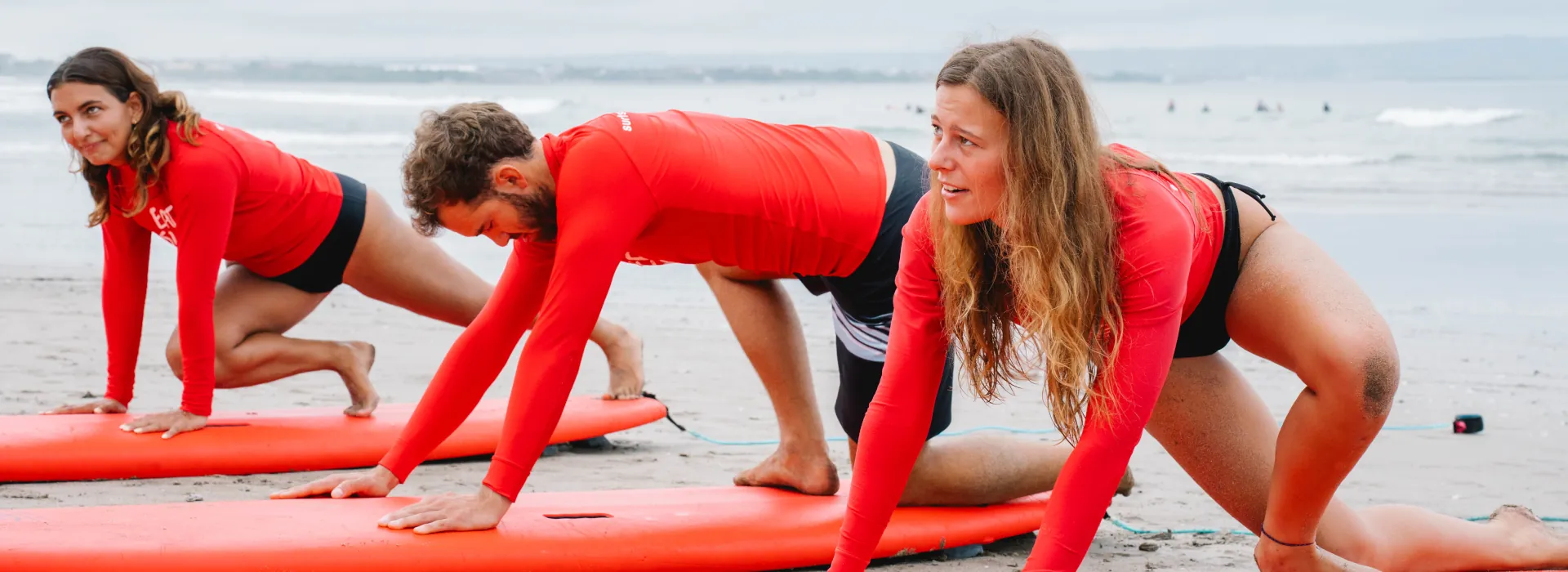
The most important move when surfing is the pop-up! This is when you move from lying on your belly, paddling, to standing on your board and riding the wave. When you look at the pro surfers it might look easy and effortless, like a mini-explosion. But don’t worry, with three simple steps, and again, practice, you’ll master this technique much quicker than you might think.
Step one: place your hands flat on the board next to your chest without holding on to the rail, then lift your chest while keeping your hips low and looking forward.
Step two: then first bring your back foot forward, positioning it on the board near the centre.
Step three: quickly bring your front foot up to the board, and place it between your hands. Once both feet are on the board, try to find your balance by bending your knees slightly and centre your weight over the board. Always keep your eyes focused on where you want to go, towards the beach, so don’t look down!
The best way to learn the pop-up and to avoid common mistakes is to start making yourself familiar with the right movement on dry land. We see a lot of intermediate surfers struggle because they didn't learn the right movement on dry land first.
Before you jump into the ocean for a surf session, practise your pop-up movement on dry land 10 to 15 times. This helps your body to create muscle memory, and your body will move automatically after a while. It might feel a bit silly at first, but trust us, it will pay off big time!
#3 Speed Controlling
Once you’re balancing on your board after the pop-up, it's time to control your speed on the wave. When you are on a wave, your speed is controlled by your weight and how you position your body.
To go faster: move your weight slightly forward on the board, towards the nose (your front foot). The pressure is now more on the front and this will make the board glide faster down the wave.
To slow down: move your weight slightly backwards, towards the tail of the board (your back foot). Helping you slow down and maintain control of the board.
To go at the same speed: keep a neutral stance with the same weight on both feet for keeping a consistent speed.
While you spend more time surfing, you'll learn how to control your speed by using your body on the surfboard.
#4 Use the Turtle Roll
As you progress your skills and start paddling further out into the ocean, you’ll sometimes need to paddle through those powerful whitewater waves that crash onto the shore. This is where the turtle roll comes in.
It’s a technique where you flip yourself and your board upside down when a wave is coming near you, letting the wave pass over you. You must keep your body close to the board and once the wave has passed, gently flip yourself and the board back over.
At our Kima Surf Camps, we often practice turtle rolls during our pool sessions before heading out to the ocean. Just jump in the pool with a surfboard and one of our surf guides, and learn the turtle roll before going out into the ocean!
#5 Get Your Body Ready
Just as with any other sport, warming up is super important. So, before you paddle out, take a few minutes to prepare your body. A quick warm-up routine can help prevent common surf injuries and improve your movements during your surf session.
Your body and mind need to be ready for all the action that comes! Cardio like jogging or high knees to get your blood flowing. Afterwards use some dynamic stretches, such as arm circles, squats, leg swings, and torso twists to increase your range of motion and prepare your body for the movements of surfing.
And don't forget to practice your pop-up on dry land! Use those 10-15 reps to get those muscles going and prepare your body for the explosive movement.
A proper warm-up will make you feel energized, more flexible, and all-prepared for your surf session!
#6 Learn How to Read The Waves
Nice! You’re paddling out, feeling happy and confident, and then you see the perfect wave coming. You feel ready, but as the wave is coming closer, you’re not so sure anymore. How do you know which wave to go for? That's where wave reading comes in, an important part of surfing that comes with spending time in the water and actively wave patterns.
Before knowing how to read the waves, it's important to understand the different types of surf breaks, different types of waves, and the different parts of the wave itself. Then you can move on to the key elements of reading the waves:
Check the surf spot: what kind of break are you going to surf at? What type of wave? And what are the conditions like?
Observe the set: watch the waves carefully. See how they roll in, are they coming in sets? How many waves per set and how far apart are the sets?
Identify the Peak: the peak is the highest point of the wave, the part where the wave starts to break and where you want to take the wave.
Look for the shoulder: the shoulder is the part of the wave that peels away from the peak, the part of the wave that is not broken yet. The steeper the shoulder, the longer you can ride the wave.
#7 Learn About the Surf Etiquettes
It's important to be aware of other surfers in the water and respect them. This is where the surf etiquettes come in, a set of unwritten rules about the do’s and the don’ts while surfing. Understanding and following these are important for a safe and fun surf session! Know who has priority on the wave, avoid dropping in or snaking in on someone else's wave, and make sure you communicate with other surfers by using non-verbal or verbal signals.
Observe and ask other more experienced surfers for tips and ask your surf guide for help with this unwritten set of rules.
Ready To Put It Into Practice?
Like any other skill or movement, becoming better at these skills takes practice in and out the water. And the best way to learn this is to repeat everything and practice, practice, practice. Don’t get discouraged if you’re not succeeding right away, that’s part of the learn-how-to surf journey. Get back on your board and keep trying. Just relax, enjoy the ride and don’t forget to smile!
Join our 5-day Learn to Surf School at Kima Surf Camp in Seminyak or Canggu. Our local surf guides will teach you all these essential techniques, give you personalized feedback, and help you build confidence to ride your first waves.
In our 5-day Learn To Surf program, you'll learn everything from paddling and popping up to reading the waves and understanding surf etiquettes. We'll also teach you about safety in the water and you’ll learn how to surf in different surf conditions, all of this in just 5 days!
Don't just dream about riding waves, start doing it! Book your surf adventure today and get ready to experience the fun of riding the waves in Bali!
Book Now