

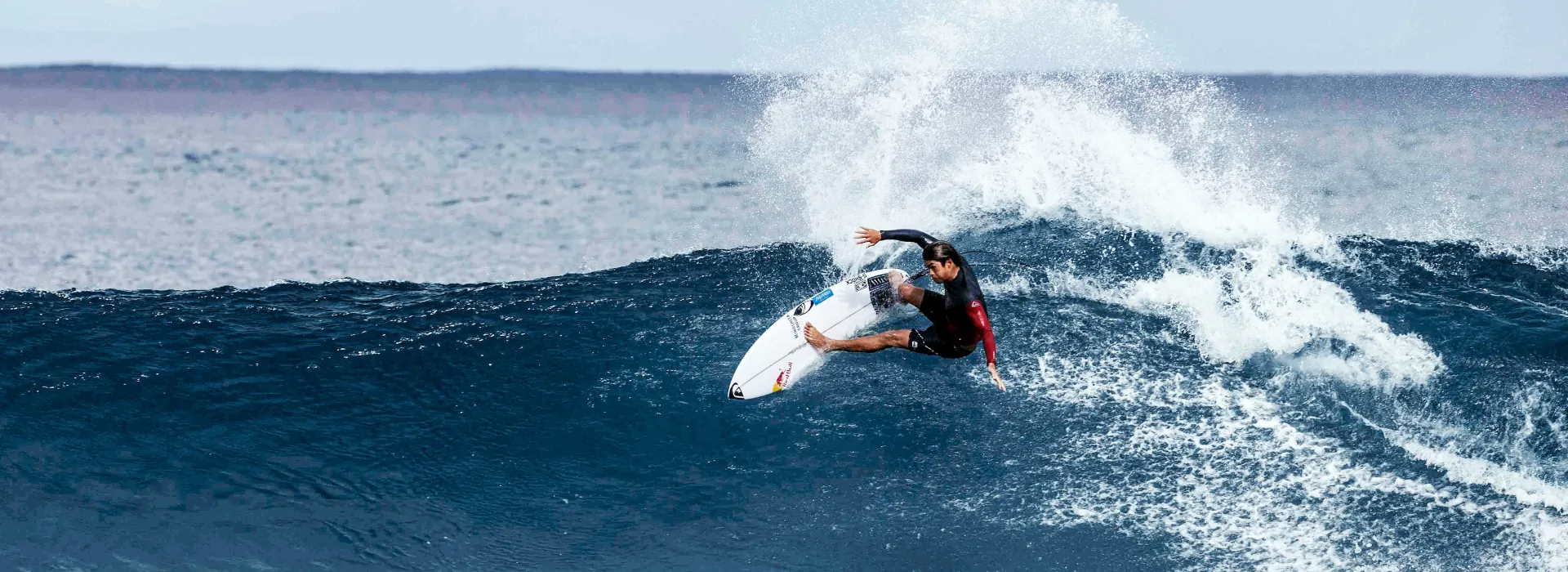
Technique is Key
Surf Techniques to Learn
Ready to learn more in your surf journey? Surfing is more than just riding the waves. There are plenty of techniques you need to learn - step by step. We listed some surf techniques for you to explore! From building strength and balance with duck diving to basics such as the Take Off. Set your goals, don’t give up and remember: never try never know!
#1 Improving your paddle
This is for you to improve your paddle! Whether you're heading to the lineup or heading towards catching the waves, learn how to paddle efficiently and effectively with these essential tips from our surf guide.
#2 Duck dive training techniques
Strengthen your surf skills with duck dive training techniques designed to improve your strength and balance. Practice holding your board underwater and build the muscle memory needed to execute flawless duck dives during your surf session.
#3 Cork Take Off
The Cork Take Off works when positioned on the peak or slightly behind it. It is helpful to use it when you have a short distance between you and the wave you are trying to catch. This method is particularly effective because it utilizes the surfboard's natural buoyancy and the wave's power to propel the surfer forward. By sinking the tail and arching the back, the surfer positions themselves to harness this energy efficiently. Mastering the cork method can significantly improve a surfer’s ability to catch waves consistently and ride them successfully
#4 The Angled Take Off
The Angled Take Off is especially helpful for serving steeper and faster waves. It prevents nose diving for a stable takeoff, enhances manoeuvrability by engaging the inside rail, enables more precise directional control, optimizes board stability in a trimming position, and the intentional lean before popping up ensures better control and a successful takeoff.
Holding the cobra pose position serves multiple purposes before performing your pop up. The duration of holding the cobra pose depends on how early you catch the wave. Surfers use it strategically to delay the pop-up, ensuring a smooth transition (in this case into the barrel). On less powerful waves, it helps to time the pop-up with the lift for an effortless takeoff. There is no specific time to hold this pose as timing is crucial in mastering this art.
The surfer delays the pop up with cobra pose only when certain about catching the wave, emphasizing the importance of perfect timing in this skill.
#5 Basics of executing a perfect cutback
Ever wondered how to master the cutback in surfing? It's not just a cool move; it's a strategic technique that keeps you in the sweet spot of the wave. Let's dive into the basics of executing a perfect cutback to use during your surf session!
For our Longboarders:
#6 Quick Way to Learn Cross Stepping on a Longboard
Use a longboard balance board! This offers benefits like improved balance, muscle memory development, risk-free practice, year-round training, immediate feedback, confidence building, and strengthening leg muscles.
It mimics the dynamic movement of waves, helping surfers develop the necessary skills and balance adjustments required for cross-stepping on a surfboard in real surfing conditions.
Try out our custom balance boards to practice your cross-stepping at our Kima surf camps like Canggu, Seminyak and Weligama 🌊
#7 Speed Generation
Generating speed is all about the compression and extension of your body.
Compression: As a surfer catches a wave, gravity is what pulls it down the wave face. In order to keep balanced, surfers compress their bodies which in turn converts potential energy into kinetic energy. Releasing this stored kinetic energy then gives the surfer a springboard to propel themselves in the desired direction of travel. (down the line)
Extension: From the compressed position at the bottom of a wave a surfer extends their body and lifts their arms in the direction of travel, by doing so un-weighting the surfboard and directing their body and surfboard back up the wave face. Repeating this compression and extension motion is how surfers generate down the line speed.
Using these body movements at the right time on the correct parts of the wave means the surfer has a constant supply of renewable energy used to perform manoeuvres.
#8 Speed Control
To become a beginner surfer involves more than just the initial pop-up; it requires mastering the art of speed control on the wave using your body weight.
Lean Back to Slow Down: Shift weight towards the tail (your back foot) to increase drag and decelerate.
Lean Forward to Gain Speed: Shift weight towards the nose (your front foot) to reduce drag and accelerate.
Equal Weight Distribution for Maintenance: Keep a neutral stance with equal weight on both feet for maintaining consistent speed.
These techniques practiced with awareness, enable beginners to confidently control their surfboard speed, enhancing their overall surfing proficiency.
And one more technique for our surfing goal: THE BARREL
#9 Learn the backhand barrel technique!
Experience the thrill of tube riding with tips for mastering the backhand barrel technique. Dive into the world of tube riding and learn how to read the wave, navigate the barrel, and make a successful exit with confidence and a smile!
